Do you focus more on features or benefits? Writing Wednesdays 5/16

If you are writing about the programs, services, products, components, and characteristics of what your organization offers, you are focusing on the features. If you find yourself describing WHAT you do and HOW you do it, you are doing a great job  of telling your readers the specifics of what to expect to find at your organization.

But that’s not really what they want to know! At least not at first.

Sure, they may say something like: “What do you all do?”

But they really mean: “How do you benefit me, my community, and the world?” “Why should I care?”

They really want to know about the benefits that result from the features you offer. They want you to answer the question: “So what?”

In Writing Wednesdays this week, we discussed the difference between features and benefits and found ways callers could begin to make that essential shift. This is one of the 3 keys to great copywriting!

Those who called in went through a brief exercise of considering what they offer and what difference that makes to their readers. We heard from a jobseeker and a mental health practitioner and offered feedback.

The exercise and recording are now available, as well as recordings of all past Writing Wednesdays calls. Share them with colleagues (they’ll thank you for it)!

Join us for the next Writing Wednesdays call on June 6 (topic: websites). Learn more here.

PS: Want to have your say about what we’ll discuss in future calls? Fill out this 2-question survey.

As seen in the current issue of The Chronicle of Philanthropy…

The current issue of The Chronicle of Philanthropy includes this year’s Continuing Education Guide. There you will find an article entitled, “A Mightier Pen Can Help Charities Spread Messages,” full of great information about the need for strong writers in the nonprofit sector. I was pleased to serve as one of the sources for this article, which shares some of my tips for boosting your writing skills.

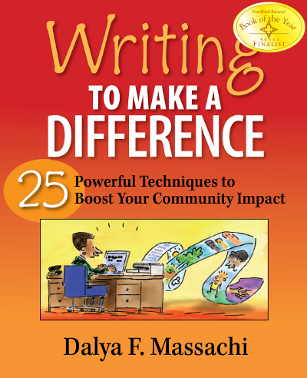
In the article, my colleagues and I agree that many nonprofit professionals see the need for improving their written communication skills, even after college. They often lack that essential training but can get it from books (such as Writing to Make a Difference), websites, workshops, and writing coaching.

A resource that was not mentioned in the article is my free Writing Wednesdays series, which offers training and feedback twice a month by phone (listen to the recordings in the archive). You can also watch my free webinars. If you’re looking for more customized training, check out the affordable custom services I offer.

If you are a subscriber to The Chronicle of Philanthropy, you can access the article HERE. Otherwise, check out the PDF right HERE.

I’d love to hear your comments!


Writing Wednesdays 5/2: fundraising appeal letters (get the recording)

If you weren’t able to join us for the free Writing Wednesdays conference call on May 2, you missed our discussion of fundraising appeal letters (aka donor letters).

No doubt you invite individuals to invest in their communities by contributing to your organization’s vision, mission, and results. What are some best practices for writing those letters on paper and online?

We discussed several tips, taken from my free one-hour webinar, and reviewed these samples.

If you would like to listen to the recording, or any recording from a previous Writing Wednesdays conference call, just check the archives.

Want to comment on any of the Writing Wednesdays calls? Just post a comment on this blog post!

The next Writing Wednesdays call will take place on May 16 and will discuss how to focus on benefits more than features. This is an essential skill for engaging your readers. You won’t want to miss the call!

Meanwhile, please let me know what you would like to discuss on future Writing Wednesdays. Just fill out this simple 2-question survey.

Talk to you soon!

PS: As a member of the Writing Wednesdays community, you are eligible for a special discount on my book, Writing to Make a Difference. You’ll find it on the bottom of the archive page!


Events now listed on this site!

Wondering where you can learn the latest on how to use your writing to make a difference in the world? Check out the events listing for how you can connect!


UPCOMING EVENTS

MAY 2012

MAY 2: Writing Wednesdays topic: fundraising appeal letters (at your desk)

MAY 8: Writing to Make a Difference: How to Create Marketing and Outreach Materials that Move Your Readers to Act (CompassPoint, San Francisco)

MAY 12: Write a Speech That’s the 3 C’s: Clear, Concise, and Compelling! (Toastmasters Conference, Novato, CA)

Description: https://col122.mail.live.com/mail/clear.gifMAY 16: Writing Wednesdays topic: how to focus on benefits more than features (at your desk)


JUNE 2012

JUNE 6: Writing Wednesdays topic: Letters of Inquiry for institutional funders (at your desk)

JUNE 19: Books & Brew talk about Writing to Make a Difference (National Conference on Volunteering & Service, Chicago)

JUNE 27: Writing Wednesdays topic: websites, especially home pages (at your desk)

JUNE 28: Writing to Make a Difference: Essential Documents for Nonprofit Jobseekers (Nonprofit Career Conference, Oakland)


PAST EVENTS

Get recordings of past events.

New online article: “Eliminating Unintended, Accidental, Repetitive Redundancies”


The second installment of my article series on Opportunity Knocks is now online. In the series, called “Putting on the Polish,” I share some tips on how to put that final touch on your documents to make them stand out and shine.

The first article was about how to cultivate conciseness. This second article is called “Eliminating Unintended, Accidental, Repetitive Redundancies” and starts out like this:

Did you notice that my title contains two redundancies (unintended/accidental and repetitive/redundancies)? Dramatic or humorous effect is the main reason that occasional repetition can be a good thing, if used well (more on that later). In most cases, however, purging your document of all forms of redundancies helps a lot.

There are actually several ways you can be redundant. Kind of ironic, don’t you think? As you might have guessed, this technique is another great way to cultivate conciseness….

Read the full article HERE.


Page 1 of 712345»...Last »